SOFIRpy: Enhancing Research Data Management and Code Documentation in Python
We’re excited to introduce SOFIRpy, a Python package that lets you co-simulate functional mock-up units (FMUs) with custom models.

We’re excited to introduce SOFIRpy, a Python package that lets you co-simulate functional mock-up units (FMUs) with custom models.
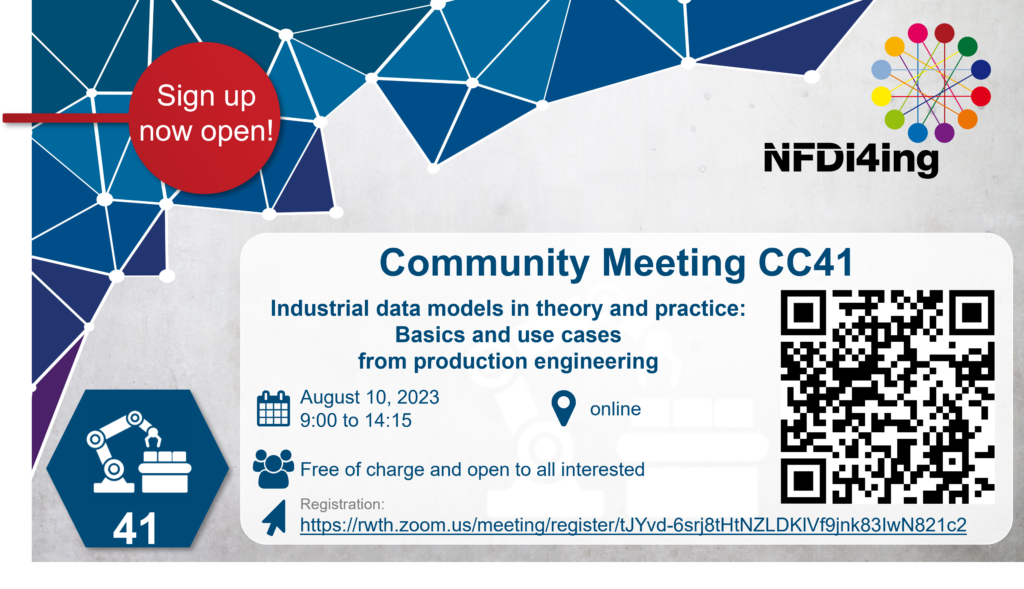
This year’s meeting of the mechanical and industrial engineering community (CC-41) focuses on the application of data models. Guests from the field of production engineering
Betty is the NFDI4Ing task area covering the research data management challenges faced by engineers who develop their own software solutions. Betty envisions a future
The latest release of the metadata4ing ontology (m4i) comes with a practical hands-on guide: Get to know basic classes and properties of m4i and see
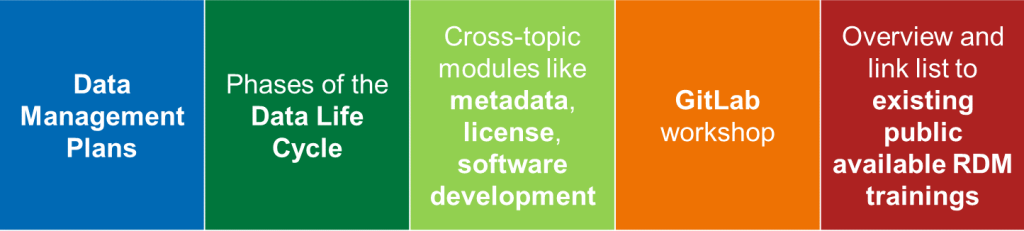
Providing Research Data Management (RDM) support and education is a central goal of NFDI4Ing. Together, the Base Service measure S-6, the Community Cluster measure CC-2,
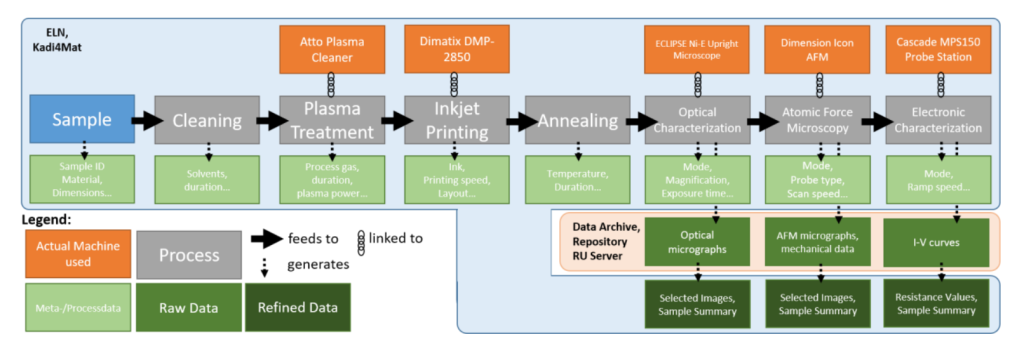
While experimental data and methods are commonly reported as “best outcome” figure of merits, the systematic process parameters (while being crucial for achieved outcome, in particular in combination and chains of different process steps) are often neglected or buried in hard-to-access lab books and similar sources. This complicates and prolongs process optimization, especially when different printing and post-processing steps need to be combined for a specific application. The project ReCIPE aimed at setting up a tool for researchers and users of printed electronics that can grow into a broad open database on process parameters and connected outcomes for the wider academic and industry-based community.

Data processing is usually not a single task, but in general relies on a chain of tools. To achieve transparency, adaptability, and reproducibility of (computational)
From its inception, members of NFDI4Ing have been working on a concept for the publication and organization of standards in the field of research data. By now, the concept is quite advanced and ready for the next step. The working group “Standardisation” (CC-5) is looking for interested persons from the community to support the work and to get the implementation underway.
ield experiments mostly take place under difficult conditions. Due to the large number of sensors and computers, large amounts of data are usually generated, and data acquisition can be affected by small errors or external events. For further processing and analysis of field data, verification of data quality is essential. To assist researchers, TA Golo has documented a website – the Data Quality Metrics Website.
The recently published “Guidelines zum Text und Data Mining für Forschungszwecke in Deutschland” describe under which conditions text and data mining may be carried out for scientific purposes and what risks exist. An online workshop, “Urheberrechtliche Fragestellungen bei der Gestaltung von Dienstleistungen zum Text und Data Mining” will take place on April 25th to address copyright issues in designing services to support text and data mining.