
The Consortium

About NFDI4ING
Engineering sciences play a key role in developing solutions for the technical, environmental, and economic challenges imposed by the demands of our modern society. The associated research processes, as well as the solutions themselves, can only be sustainable if they are accompanied by proper research data management (RDM) that implements the FAIR principles: Findable, Accessible, Interoperable, and Reusable.
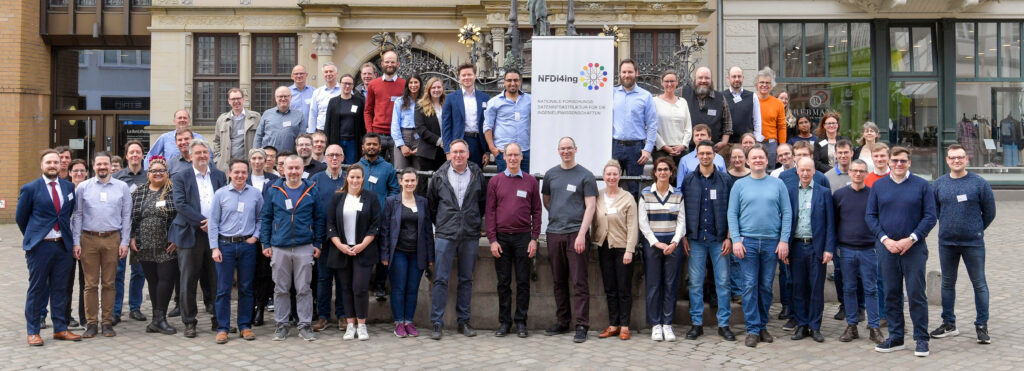
NFDI4ING brings together the diverse engineering communities to work towards this goal. As the voice of engineering within the German National Research Data Infrastructure (NFDI), the consortium develops, disseminates, standardises, and provides methods and services to make engineering research data FAIR.
Founded in 2017, NFDI4ING is one of the first consortia funded within the NFDI. Today, the consortium comprises more than 50 active members and participants and continues to grow.
Our approach
NFDI4ING develops methods, services, and infrastructures that support researchers throughout the entire research data lifecycle.
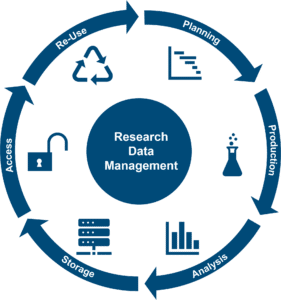
Since 2019, NFDI4ING has been working towards the goals outlined in its initial proposal, which is available here.
Looking ahead, we aim to further close data cycles by minimising friction and redundant work while eliminating dead ends in the scientific information flow.
As a foundation, NFDI4ING leverages self-contained data entities embedded in knowledge graphs. Furthermore, we implement FAIR Digital Objects (FDOs) and established vocabularies to ensure that engineering research data is FAIR and AI-ready.
Our Guiding Principles
The following ten guiding principles summarise NFDI4ING’s approach.
1. The consorium is commited to become a central contact for the engineering community in all things related to professional research data management. To achieve this, we build up a long-term structure for inter-community communication, training and support. One example is the NFDI4ING helpdesk. It connects the user’s requirements with our own expertise, and, when necessary, the expertise of other RDM support structures, in particular local RDM teams, federal state RDM initiatives, related services from other NFDI consortia, and the EOSC. For closer collaboration, our Special Interest Groups are open for everyone and foster inter-community communication and development. We provide an annual conference and regular community meetings.
We also collaborate with local and federal state RDM structures, including the “Landesinitiativen” (e.g., HeFDI, FDM.NRW, TKFDM, and more) and the data competency centres (“Datenkompetenzzentren”). We support DFG funded collaborative research groups (e.g., CRC, EXC) and foster a community network of embedded and central data stewards in those research programs. We collaborate in trainings with these groups and link it to NFDI section EduTrain and the Data Literacy Alliance (DALIA).
2. We make our developments sustainably available and ensure German- or European-wide scalability. Our task areas areas focused on overarching solutions guarantee the build-up of integrated long-term services that are accessible to all scientists (e.g., via NFDI-IAM) and provide clear points-of-entry. We follow open procedures at all levels of service development. We regularly check for new or changed community needs or requirements through our archetype task areas and surveys.
3. We set up common infrastructures and put the concept of FDOs into practice by agreeing on a common information model (CIM) in the consortium. Based on the CIM we implement federated semantic knowledge graphs which connect to our services. We include existing federated storage infrastructures into our portfolio and connect our services to those whenever applicable, incl. setting up a federated dataset search and bundling our training efforts and materials.
The NFDI4ING RDM Copilot provides a single point of entry for assisted RDM planning and continuous support for RDM tasks. These efforts standardise and scale our services and form a basis for a long-term integrated infrastructure that will merge into “OneNFDI”.
4. Since 2019 we are working on delivering end-to-end solutions to allow engineers to achieve closed data cycles in their day-to-day practice. We keep a keen eye on the results of our efforts and monitor progress according to our concept of Integration Readiness Levels (IRL).
5. Our FDOs make data sets and software machine-actionable and AI ready. Continuous further development and integration guided by our Integration Readiness Levels (IRLs) foster interoperability and re-usability throughout data life cycles. We establish bridges to AI tools in our services on both ends of the data lifecycle, i.e. data supply and data usage.
6. We offer patterns for curricula as well as their regulations for examinations and doctoral programs and promote examples from NFDI4ING’s co-applicant institutions. We deliver best-practice guides and set standards for RDM on all scales from special data handling tasks to entire tool chains.
7. We actively support the cultural change towards research assessment reform and FAIR scientific data management and stewardship. In collaboration with the NFDI section EduTrain we develop certificates for RDM expertise in engineering and further build on the concept of EduBricks. We develop and implement engineering related EduBricks for the needs of the NFDI4ING community. For dissemination, we run the journal ing.grid as publication platform for datasets, software and manuscripts on RDM practice in engineering.
8. We continue to integrate industry partners and include data custody models and infrastructures into our portfolio. Via our advisory board we regularly receive and implement input and feedback from industry partners. Our connection to the International Data Spaces Association (IDSA) will be further expanded. We continue to work on the community-driven development of standards by providing a platform and workflow comparable to the IETF’s requests for comments (NFDI-RFC). In this, we connect to national and international regulatory bodies like ISO/DIN and contribute to the NFDI section Industry Engagement.
9. We play a key role in several Base4NFDI services (i.e., IAM4NFDI, PID4NFDI, Jupyter4NFDI, DMP4NFDI, KGI4NFDI, TS4NFDI, and nfdi.software). We are active in all sections and bodies of the NFDI e.V. and closely collaborate with the other NFDI consortia on trans-consortial use cases. A focus lies on collaborating with consortia active in at least one of the DFG research subject areas 4.11 through 4.51 and thus closely related to engineering sciences. These include NFDI4Cat, DAPHNE4NFDI, NFDI-MatWerk, NFDI4DataScience, NFDI4BioImage, NFDI4Energy, NFDIxCS, NFDI4Culture, and NFDI4Objects. Beyond DFG classifications, we also include NFDI4Chem and MaRDI in the list of consortia closely connected to engineering. Thematically, cultural and social aspects of engineering (e.g. on data related to the built environment with NFDI4Objects and NFDI4Culture) and the development of new use cases that result from combining research data from different disciplines are foci of our efforts looking forward. To further support this, we foster the cross-linking of knowledge graphs and the integration of information models.
10. We actively develop and plan to implement an operational model that supports our activities and services beyond the projected end of funding in 2030. This process is framed by and in accordance with the activities of other actors, i.e. the German Council for Scientific Information Infrastructures (Rat für Informationsinfrastrukturen, RfII), the NFDI e.V., and the Joint Science Conference (Gemeinsame Wissenschaftskonferenz, GWK).