
SciMesh for RO-Crate
Quite often, data needs to have a well-defined container in order to enhance interoperability. RO-Crate is a mature solution for this need. In addition to rich metadata, RO-Crates also contain the raw data. This way, users of the container gain access to data of all stages of the scientific workflow. Not only seamless re-use is enabled by this, but also reliable examination and check for reproducability.
“SciMesh 4 RO-Crates” (SM4RO-C) provides a way to embed graphs from the knowledge graph schema SciMesh into an RO-Crate container to produce self-contained artefacts of scientific results and insights, together with their context, provenance, and bulk data.
The figure below shows the technology stack of SM4RO-C. Its three pillars are TheELNFileFormat and SciMesh. TheELNFileFormat in turn is a specialised RO-Crate as a ZIP file, an RO-Crate “profile”. In a future version of SM4RO-C, we plan to add minor enhancements that let it look like an EPUB if opened with e-reader software. You might think of SM4RO-C containers as heavily enriched, highly-structured, machine-actionable ZIP files.
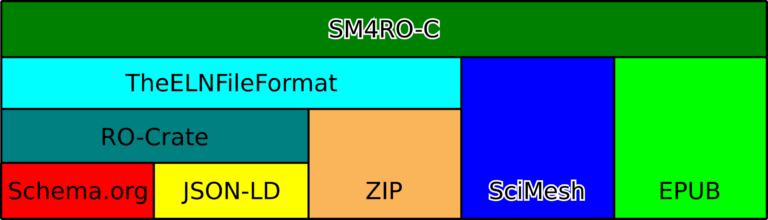
Researchers can use SM4RO-C containers to share well-defined research data objects, e.g. all data of a semiconductor device, with peer researchers. Electronic lab notebooks can use SM4RO-C to exchange data between different ELNs, or to export their data to disk for backup or migration purposes. Moreover, SM4RO-C containers are suitable for effective publication of research results.
Link to the service
Terms of use & restrictions
SciMesh does not have any deployment somewhere. It is a specification – or format – that everyone can implement. NFDI4ING creates a reference implementation in JuliaBase [4].
Contact
Torsten Bronger, t.bronger@fz-juelich.de
References
publications that reference (or report on using) the service
Torsten Bronger et. al., SM4RO-C specification, https://scimesh.org/sm4ro-c/SM4RO-C.pdf
TheELNFileFormat, ELN Consortium, https://github.com/TheELNConsortium/TheELNFileFormat
Torsten Bronger, Michael Selzer, Hartmut Schlenz et. al., SciMesh, https://scimesh.org/about
Torsten Bronger, JuliaBase, https://juliabase.org