
What is the Metadata Profile Service?
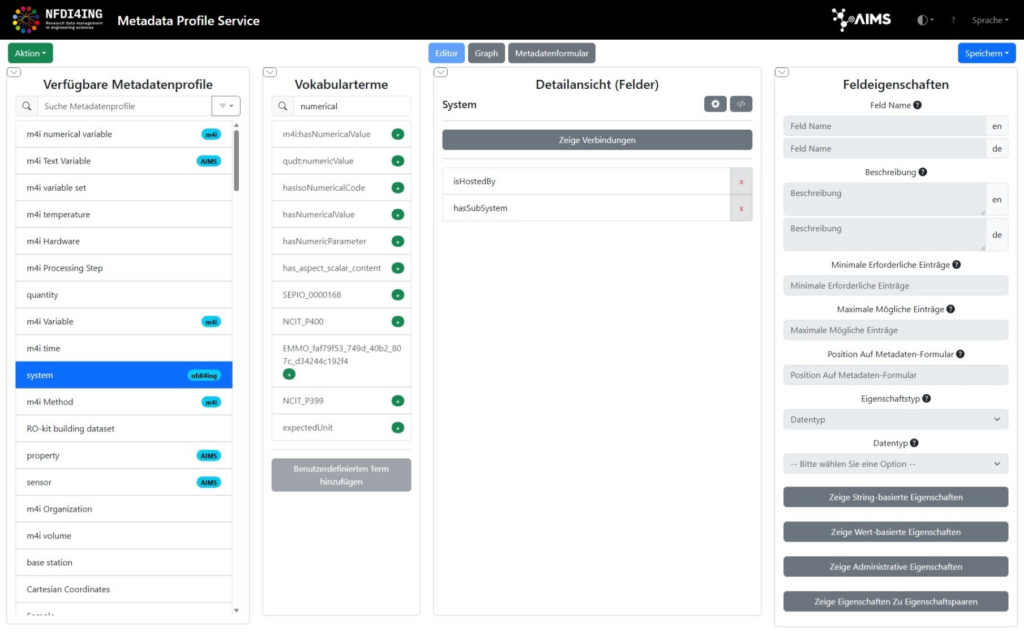
The Metadata Profile Service (MPS) is a web-based platform for creating and managing structured metadata profiles through a graphical user interface.
It supports users in transforming existing vocabularies and standards into practical metadata templates by creating RDF-compliant application profiles using SHACL that can support more consistent semantic data structures and knowledge graph-ready metadata.
The MPS is designed to make semantic metadata profile creation more accessible, including for users without extensive ontology expertise.
Why use the MPS?
Applying metadata standards and semantic technologies in practice can be complex, particularly when combining existing vocabularies with formal schema requirements.
The MPS supports this process by enabling users to:
- Combine terms from existing terminologies into metadata profiles which serve as templates for creating RDF data for consistent knowledge graphs
- Reuse and adapt existing profiles through a browser-based interface
- Define datatypes, value restrictions, and relationships
- Collaborate on profile development from draft to publication
- Curate profiles and tag them as recommendations for their community
It supports users in transforming existing vocabularies and standards into practical metadata templates by creating RDF-compliant application profiles using SHACL. The resulting metadata structures can support more consistent semantic data modelling, validation workflows, and knowledge graph-ready metadata.
Metadata profiles created with the MPS can be integrated into services and infrastructures such as the NFDI4Ing Knowledge Graph Environment (KGE), INGEST or Coscine.
Who is it for?
The MPS is intended for users involved in the creation, standardization, or management of metadata in research contexts.
This includes:
- Researchers
- Data stewards and research data managers
- Scientific infrastructures and NFDI initiatives
- Projects developing domain-specific metadata schemas
It is particularly relevant for users seeking to develop standards-based metadata profiles through a browser-based interface.
How does it work?
The MPS is openly accessible in the browser and currently does not require registration or user accounts.

Current scope and future development
The MPS currently focuses on browser-based creation, collaborative drafting, publication, and reuse of metadata profiles.
Ongoing and future development includes:
- Further user interface refinement to simplify navigation and profile creation workflows
- Integration with Electronic Lab Notebooks (ELNs) and related research tools
- Expanded access and collaboration features as the platform continues to develop.
Getting started
Try the demo: https://profiles.nfdi4ing.de
Contact
Marc Fuhrmans, marc.fuhrmans@tu-darmstadt.de
References
Preuß, N., Bodenbenner, M., Heinrichs, B., Windeck, J., Moser, M., & Fuhrmans, M. (2023). Creating application-specific metadata profiles while improving interoperability and consistency of research data for the engineering sciences. https://doi.org/https://doi.org/10.26083/tuprints-00024573
Grönewald, M., Mund, P., Bodenbenner, M., Fuhrmans, M., Heinrichs, B., Müller, M. S., … Stäcker, T. (2022). Mit AIMS zu einem Metadatenmanagement 4.0: FAIRe Forschungsdaten benötigen interoperable Metadaten. In V. Heuveline & N. Bisheh (Hrsg.), E-Science-Tage 2021: Share Your Research Data (S. 91-104). Heidelberg: heiBOOKS. https://doi.org/10.11588/heibooks.979.c13721