
Who is Doris?
The NFDI4Ing task area Doris designs transferable research data management concepts and tools for data from high-performance measurement and computation (HPMC).

The NFDI4Ing task area Doris designs transferable research data management concepts and tools for data from high-performance measurement and computation (HPMC).
Discover ing.grid, the journal for FAIR data management in engineering sciences.
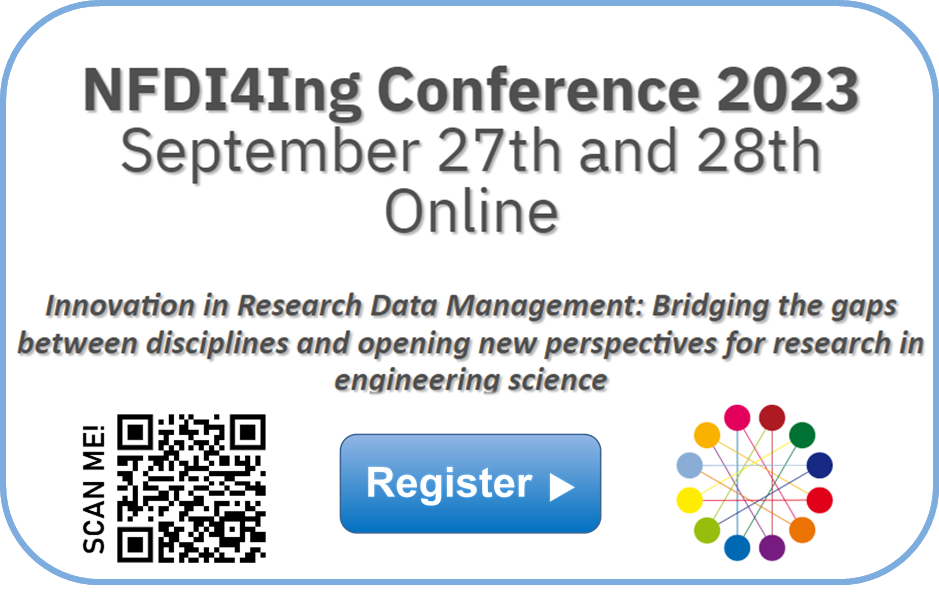
We cordially invite you to this year’s NFDI4Ing Conference 2023 on 27th and 28th September 2023!
We’re excited to introduce SOFIRpy, a Python package that lets you co-simulate functional mock-up units (FMUs) with custom models.
The IAM4NFDI project team invites you to a workshop that will provide the technical and organisational basics for the operation of a Community AAI. Read more…
The next meeting of the NFDI4Ing Special Interest Group (SIG) Training & Education is on Friday, September 1st, starting at 10 PM. Read more…
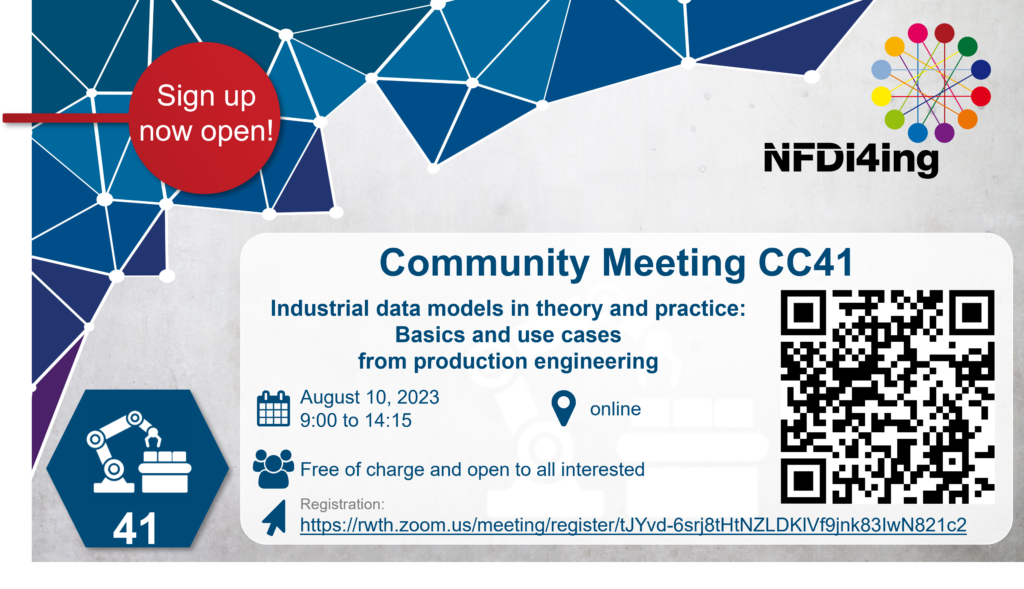
This year’s meeting of the mechanical and industrial engineering community (CC-41) focuses on the application of data models. Guests from the field of production engineering
Betty is the NFDI4Ing task area covering the research data management challenges faced by engineers who develop their own software solutions. Betty envisions a future
The latest release of the metadata4ing ontology (m4i) comes with a practical hands-on guide: Get to know basic classes and properties of m4i and see
Am 26. May 2023 veranstaltet die NFDI4Ing das zweite Community Meeting des Jahres mit Themen wie Datenschutz und dem richtigen Umgang mit Forschungsdaten… Read more…