

Promoting a cultural change towards FAIR research data management (RDM) in engineering has been a key objective of NFDI4ING since its beginnings in 2017. An important part of this mission is bringing RDM into engineering education and equipping early-career researchers with practical skills for managing their research data.
Our approach is collaborative: NFDI4ING develops concepts and supporting materials, tests them with pilot users, and makes them available to the engineering community for adaptation and further improvement.
A great example is our collaboration with Hochschule RheinMain. Professor Eißler, Dr. Judith Dähne and Florian Bendel adapted the NFDI4ING RDM Basics series and integrated it into the training programme of their Promotionszentrum Systemintegrierte Ingenieurwissenschaft (doctoral center for system-integrated engineering science). We are grateful for their commitment to taking up our materials and developing them further through practical application.
Turning RDM principles into practice
The resulting course primarily aims to raise awareness of RDM and is intended for researchers around six to twelve months after starting their work, when they have encountered their first research data challenges, but can still establish good practices early in their projects.
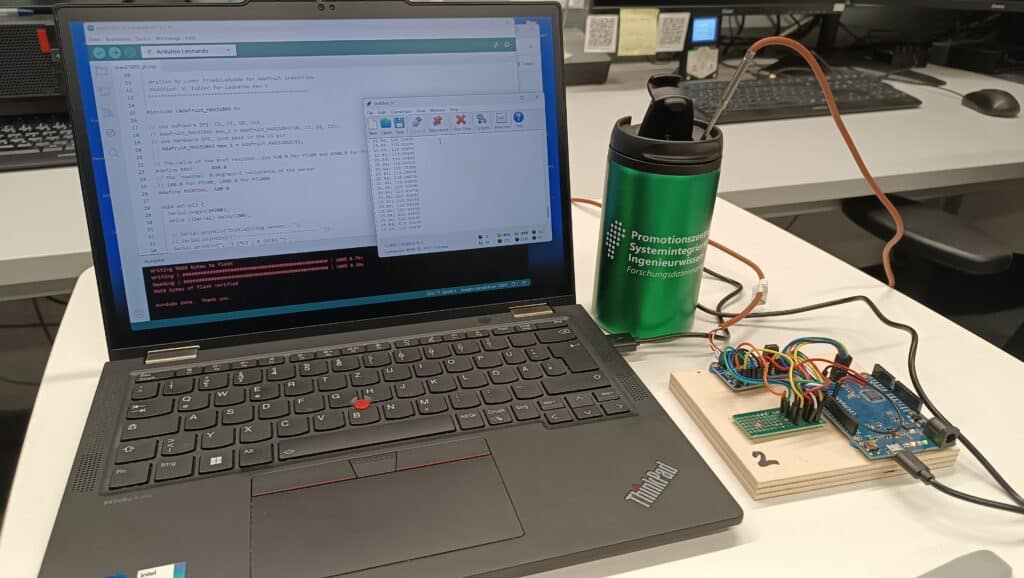
Following the research data lifecycle, the course combines theory with practical exercises and connects the individual stages to the FAIR Principles. Participants create a data management plan using RDMO and then conduct a temperature measurement experiment documented in eLabFTW. The experiment deliberately introduces realistic challenges: participants receive different instructions, choose from a range of measuring equipment and encounter obstacles during data collection. The following day, access rights are rotated so that nobody analyses their own data. This makes the importance of good documentation immediately tangible, and the data exchange was subsequently rated as one of the most instructive parts of the course (although initially viewed critically).
The training also addresses file organisation, archiving, repositories, DOI assignment, licensing and scientific publication, concluding with a sample paper based on the experiment.
Learning from the first run
The first implementation also provided useful lessons for future iterations. Working with the Arduino IDE and CoolTerm took longer than expected due to participants’ different levels of technical experience. Yet these challenges are part of the learning process: dealing with data-generating software, different tools and incompatible data formats is itself an important aspect of RDM.
Feedback was predominantly positive, particularly regarding the lifecycle approach and the combination of a data management plan with a practical experiment. Participants expressed interest in more content on research software management, anonymisation, legal issues and research ethics. Future iterations will also provide more time for the experiment and data analysis.
For NFDI4ING, this collaboration shows how community-driven RDM education can work: materials become most valuable when educators adapt them to their own contexts, put them into practice and improve them based on experience. Our sincere thanks go to Professor Eißler and Florian Bendel at Hochschule RheinMain for doing exactly that.
Thorsten Schwetje