
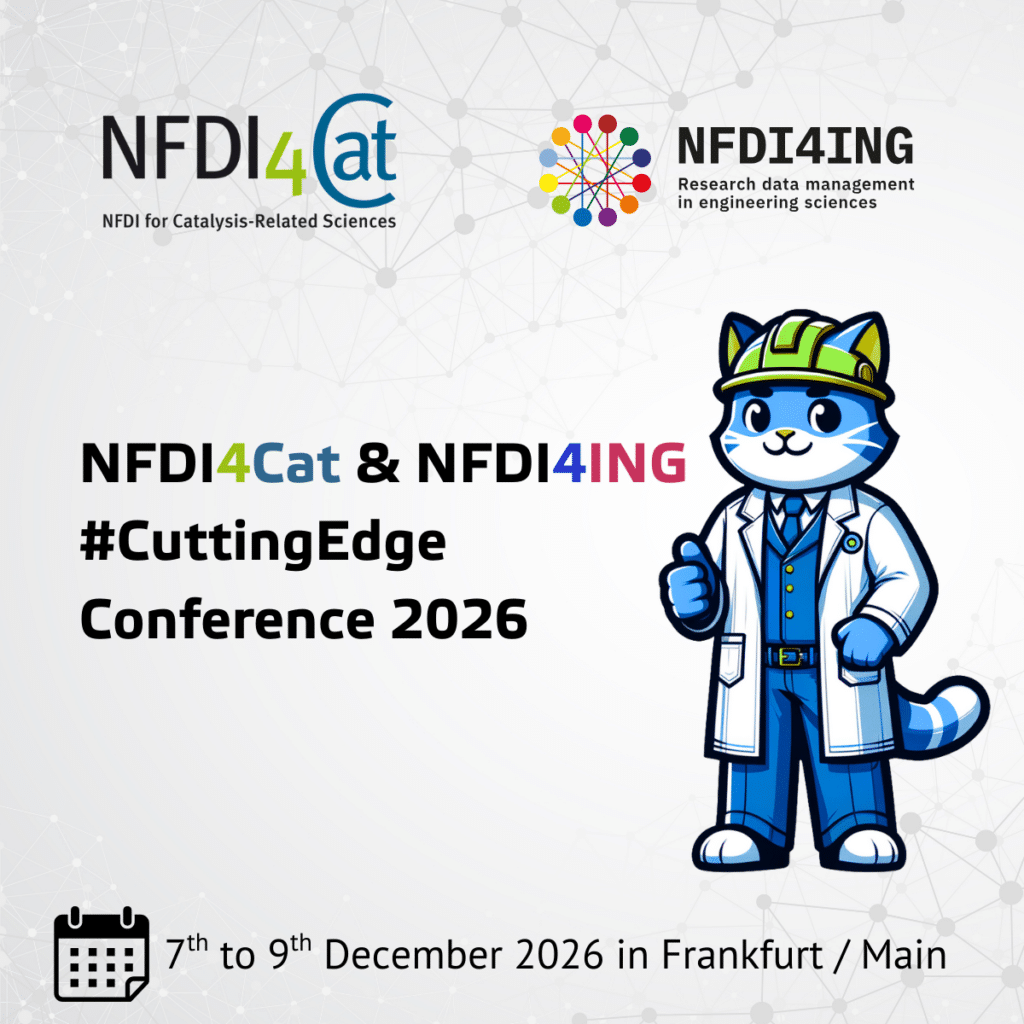

Together for better research! In 2026, NFDI4Cat and NFDI4ING will host the joint NFDI4Cat & NFDI4ING #CuttingEdge Conference at the DECHEMA venue in Frankfurt am Main.
By bringing together communities from catalysis and engineering, the conference will foster collaboration, explore synergies, and contribute to advancing the digital transformation of science.
Participation is free of charge.
We’re looking forward to welcoming you to Frankfurt!
Accessibility
The DECHEMA venue is fully accessible, with step-free access, wheelchair-accessible doors and restrooms. All main areas, including the entrance, event hall, and facilities, can be reached without barriers.
Registration
Registration is now open and can be completed via this link.
Following the conference, our internal NFDI4ING team meeting will take place from December 9, 2026, 3:00 pm to December 10, 2026, 2:00 pm. Registration is handled via the same link, where you can sign up separately for the team meeting as well.
For hotel recommendations visit: DECHEMA | Hotel Recommendations
For information on how to get there, please see: https://dechema.de/en/anfahrt.html
Abstract submission
The abstract submission is now open and can be submitted here.
Submission deadline: 9 October 2026
Programme
Programme will follow.
Keynote Speakers
Prof. Dr. Sonja Schimmler
Title: Research Data Infrastructures in the Age of Generative AI
Abstract: Generative AI is reshaping how researchers create, share, and reuse articles, data, models, and code. As this complicates transparency and reproducibility, research data infrastructures must adapt accordingly. This talk examines how these systems are evolving to manage diverse scholarly artifacts and leverage AI themselves.

Dr. Frederik Springer
Title: PIDINST in Practice: Mapping the Landscape of Research Instrument Registration for Catalysis and Engineering
Abstract:
Persistent Identifiers for instruments make scientific equipment unambiguously identifiable across platforms and over time, enabling datasets to be traced back to their source instruments. This talk analyzes the current landscape of instrument registration using PIDINST Search and examines practical use cases in catalysis and engineering research, including guidance on metadata best practices for NFDI4Cat and NFDI4ING communities.

Dr.-Ing. Stephan Ferenz
Title: Services as foundation for research data infrastructure – in NFDI4Energy and the NFDI
Abstract:
In the evolving landscape of research data infrastructure, services are a central way to support researchers, data stewards and others with their research data management tasks. As consortium for energy research, NFDI4Energy offers multiple services for these different tasks with domain-specific adaptions. These services are organized in a joined quality-ensured NFDI4Energy service portfolio. Based on this portfolio, NFDI4Energy aims to integrate these services into the NFDI service catalog which is currently discussed in the NFDI.
This talk will give an overview of the NFDI4Energy service portfolio and how this could fit into the emerging NFDI service portfolio.

Dr. Kevin Maik Jablonka
Title: Learning What Matters: Patterns, Predictions, and Actions for Materials
Abstract:
Materials discovery faces a fundamental challenge: small, but systematic effects shape material performance, yet these patterns are too complex to encode explicitly in traditional approaches. Machine learning offers a path forward by learning to capture the tacit and fuzzy dimensions of materials behavior that guide expert intuition.
In this talk, I’ll present a framework for translating patterns into predictions, and predictions into actionable design decisions. I’ll show how we can mine diverse materials data to construct robust training sets, develop models, and – critically – evaluate whether these models actually work for real-world tasks. Through applied examples, I’ll discuss how rigorous evaluation reveals when models capture meaningful patterns versus when they just develop fuzzy heuristics via pattern matching.
The goal isn’t just better predictions, but reliable tools that help us design materials that work in practice, not just on paper.
Elena Volkanovska
Title: LLM-Supported Research Data Management in the Engineering Sciences: Experiences from NFDI4ING
Abstract:
NFDI4ING is integrating large language models (LLMs) to help engineer-ing researchers find the tool or service that best matches their research data management (RDM) needs. In a working group dedicated to developing LLM-powered tools for engineering research workflows, the consortium has developed the NFDI4ING AI Assistant: A standalone web service for navigating the rich landscape of tools, services, recommendations and research produced by NFDI4ING over the past six years. The centralized service is complemented by several specialized chatbots that support researchers while using a specific service. This talk focuses on the development framework underpinning the NFDI4ING AI Assistant, which includes a continuously updated knowledge base, whose ingestion pipeline detects changes in existing content and tracks sources for new content, a question-answering agent that triages queries by complexity, and the evaluation steps implemented along the way. Upcoming work will integrate existing NFDI4ING services into the Assistant via Model Context Protocol (MCP), starting with the Research Software Finder. The talk illustrates how generative AI can lower the barrier to using dedicated research data management tools across the research data lifecycle.