From Racing Cars to FAIR Data: FIONA’s Summer School 2026
What do toy racing cars have to do with FAIR research data? Quite a lot! Looking back at the NFDI4ING Summer School in Aachen, where participants put RDM into practice across the entire data life cycle.
How do you properly “drive” Research Data Management (RDM) in the engineering sciences? Back in August, students and researchers from the engineering sciences came together in Aachen for three days to explore this question in a practical, hands-on Summer School hosted by NFDI4ING’s archetype FIONA.
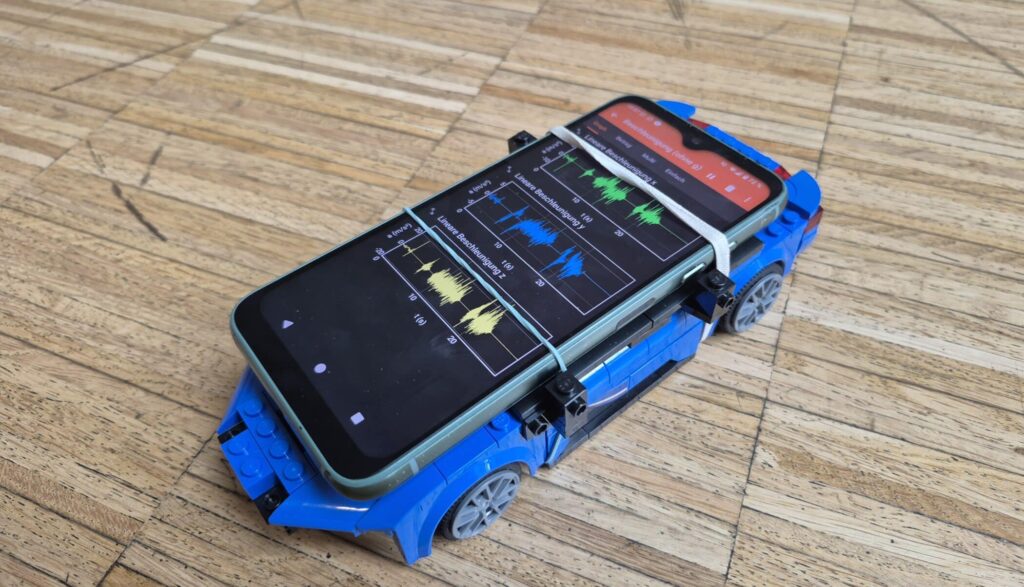
Over the three days, the participants worked through the entire data life cycle (DLC) using a fictional research project. At the heart of the exercise was a deliberately simple but distinctly engineering-focused use case: collecting acceleration data while driving a toy racing car.
Using their smartphones and the phyphox® app, participants recorded acceleration sensor data and followed it through all stages of the research data life cycle. They planned their experiment with a Data Management Plan (DMP) using RDMO, visualised and analysed the collected data in prepared Jupyter Notebooks, and explored how Python code and Markdown documentation can make analyses transparent and reproducible.
An image of the platform used during the three days: a building bricks "racing car" with an attached smartphone.
The participants then identified and added relevant metadata, discussed dataset descriptors and RO-Crates, and finally published their datasets on Zenodo in the newly established Racing Data Motors community.
But research communication does not have to end with a traditional paper. Instead, participants were invited to experiment with different formats of scientific communication. Their creativity resulted in videos, comics, posters, drawings and more. An outlook on data reuse completed both the data life cycle and the Summer School.
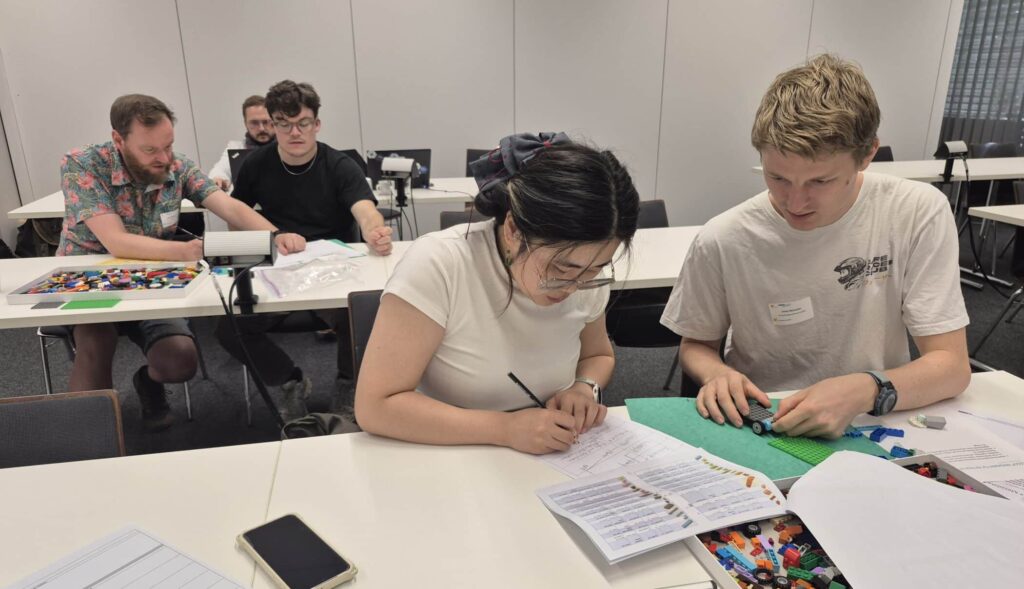
Participants working on building the racing car.
The racing-car use case was intentionally designed to be straightforward, allowing participants to focus on RDM principles and practices without being distracted by excessive domain complexity. The Summer School itself follows a modular structure, making it adaptable to different time frames. Each module combines theoretical input on RDM fundamentals with a practical lab for hands-on application.