NFDI4ING strengthens data literacy from day one: a digitalization lab course from TU Darmstadt inspires other universities to integrate research data management into engineering education.
Together for Data Literacy from Day One: NFDI4ING Strengthens Research Data Management in University Teaching
What sets the concept apart is its openness: it is not only implemented locally but also shared with the broader academic community. TU Munich and TU Dortmund, for example, are developing their own courses inspired by the Praktikum Digitalisierung, tailored to their specific study programs and areas of focus. In this way, NFDI4ING – together with initiatives such as the Association of Engineering and Computer Science Faculties (Fakultätentage der Ingenieurwissenschaften und der Informatik) – forms a dynamic network in which experiences and best practices are exchanged and continuously refined.
“Our goal was to promote data literacy from the very beginning — to create a teaching format that conveys digital skills in a hands-on, practical way,” says Prof. Peter Pelz, Head of the Institute for Fluid Systems Engineering and spokesperson for NFDI4ING. “The fact that other universities are adopting and further developing our concepts is the best proof that open science also works in teaching.”
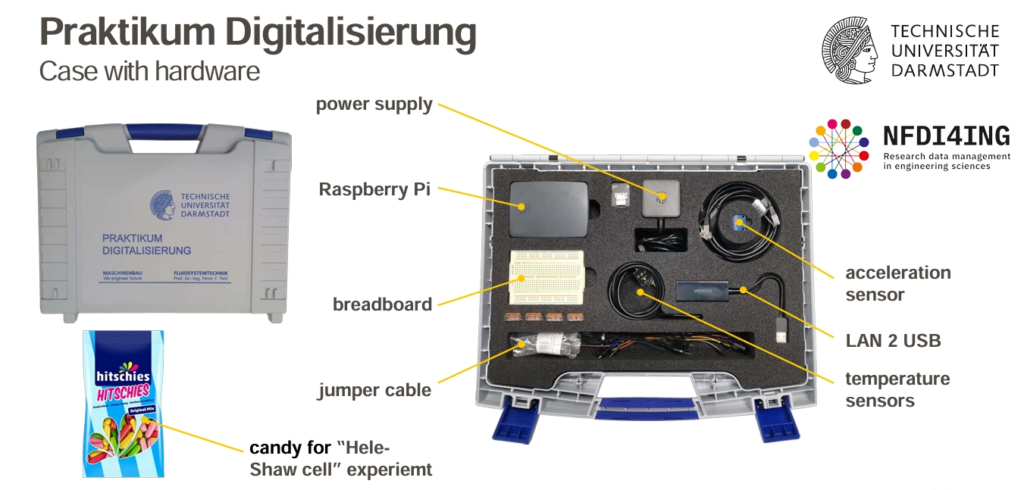
Each student takes home a case containing the necessary hardware equipment, such as the Raspberry Pi and sensors.
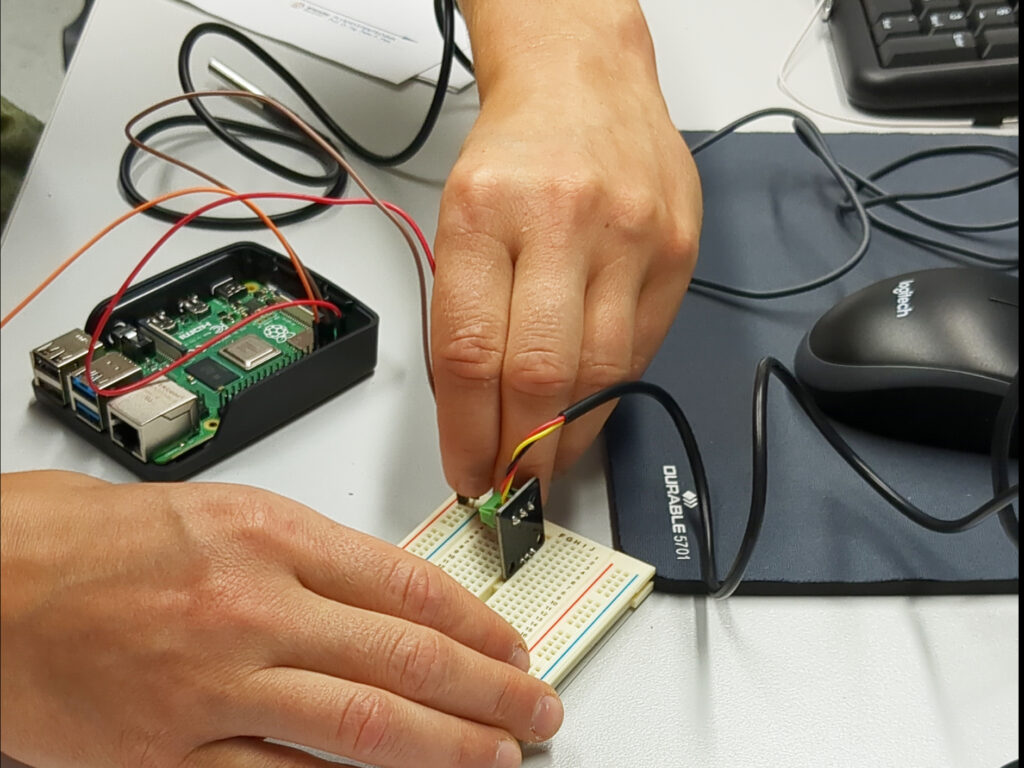
The Praktikum Digitalisierung equips students with essential digital skills for working with research data – from data acquisition and analysis to transparent and sustainable documentation. A particular highlight is the series of “kitchen table experiments” which serve as preparation for laboratory work. Using a specially designed hardware kit that includes a Raspberry Pi and various sensors, students can conduct experiments independently at home. In the process, they learn to integrate the FAIR principles (“Findable, Accessible, Interoperable, Reusable”) into engineering workflows. This makes research and digitalization tangible from the very start of their studies.
An information package on the Praktikum Digitalisierung is available here.