From stained glass to data models: “Windows on Data” brings together consortia across the NFDI to explore how heterogeneous research data can work seamlessly together.
Trans-consortial Case Study “Windows on Data”
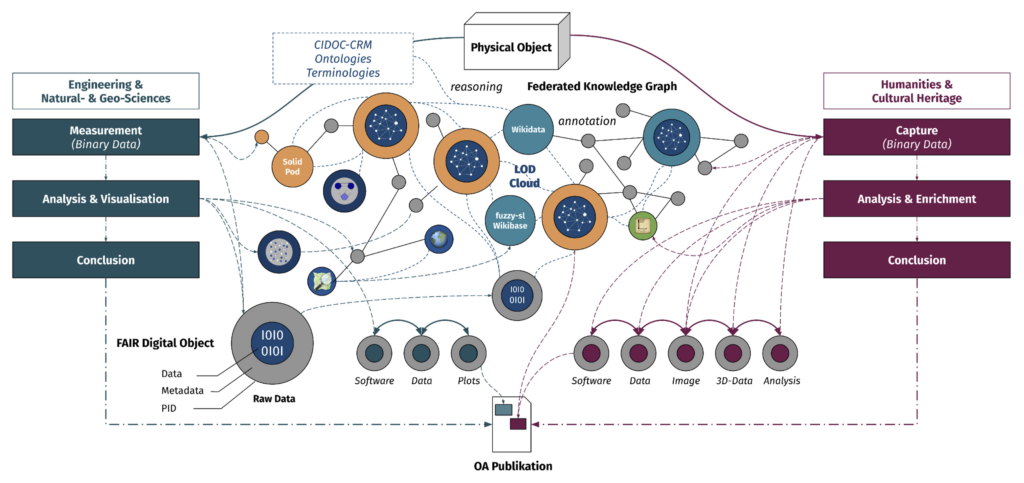
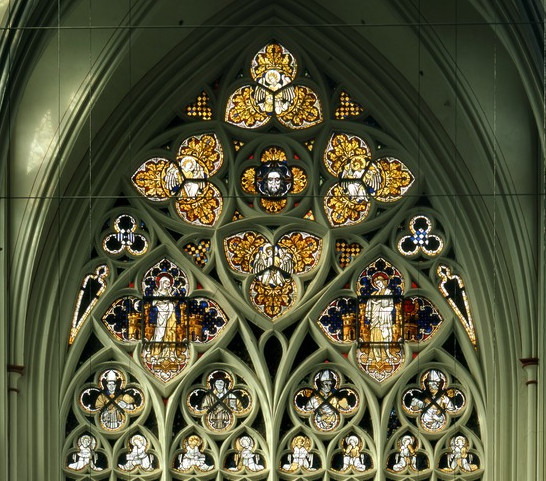
The vision of “One NFDI” requires that highly heterogeneous research data be interoperable across discipline boundaries. A trans-consortial working group is addressing this challenge in the case study “Windows on Data”, using research data related to colored church windows from the Corpus Vitrearum Medii Aevi (CVMA). In addition to the art-historical cataloguing of stained glass in the CVMA, which is part of the consortium NFDI4Culture, this also involves object biographies, building research, and issues of conservation and restoration in the scope of NFDI4Objects; mathematical methods and statistical analyses from MaRDI; architectural and building research in NFDI4ING; and materials science perspectives in from MatWerk. The research data span imaging, measurement, and conservation records, as well as semantic annotations and computational models.
Illustration of complementary perspectives on research objects.
In recent years, the group has examined the CVMA data from a variety of interdisciplinary perspectives. In a workshop titled “Glass and Data – Multidisciplinary Perspectives on Historical Materials”, the consortia NFDI4Culture, MaRDI, and MatWerk explored how cultural heritage, materials science, and mathematics can collaborate on a shared application case. Since early 2024, CVMA Freiburg and Task Area 6 in NFDI4Objects have been developing an object biography as an application case for the NFDI4Objects object ontology.
During a workshop in early December 2025, the participants agreed to continue the case study and joint work on bringing together the many perspectives. The aim is to strengthen collaboration and deepen the networking among all contributors. This collaborative effort stands as a best-practice example of the vision behind ‘One NFDI,’ demonstrating how shared challenges can be addressed more effectively through coordinated, cross-consortial expertise.