Research engineers often face a flood of heterogeneous data. A recent use case demonstrates how the Open Research Knowledge Graph (ORKG) helps transform 25 complex energy studies into a single, transparent, and machine-actionable resource.
In energy system research, as in many engineering disciplines, computer models are essential for simulating future scenarios. However, these models often rely on vast amounts of “framework data”, i.e. assumptions about population growth, industrial demand, or transport services. When these input assumptions are not clearly documented, comparing results becomes nearly impossible, leading to a landscape of conflicting studies where the root causes of differences remain hidden.
To address this, NFDI4ING’s Task Area ELLEN utilized the Open Research Knowledge Graph (ORKG) to organize and analyze scientific knowledge from 25 major studies on Greenhouse Gas (GHG) reduction for Germany.
The Challenge: The “Hidden” Influence of Input Data Engineers know that the selection of input data directly influences the optimal transformation path of a system. In the analyzed use case, researchers wanted to determine which sectors (energy, industry, buildings, transport) were most sensitive to changes in framework data. To do this effectively, they needed to move beyond static PDF publications where data is trapped in text or images, and towards structured, comparable data.
The Solution: Structured Knowledge with ORKG Instead of traditional text-based reviews, the team organized the 25 studies as structured contributions in the ORKG. They used ORKG’s standardised templates to ensure that every study was described using the same metadata profile. The templates used can be viewed here and here. They also focused on ensuring consistent and clear terminology by integrating the Terminology Service (TS) and the Open Energy Ontology (OEO), so that ambiguous terms were replaced with clearly defined concepts. This ensured that specific engineering terms, such as different sectors, were interpreted consistently across all datasets.
The result was a persistent, versioned, and citable ORKG Comparison that acts as a live database rather than a static table.
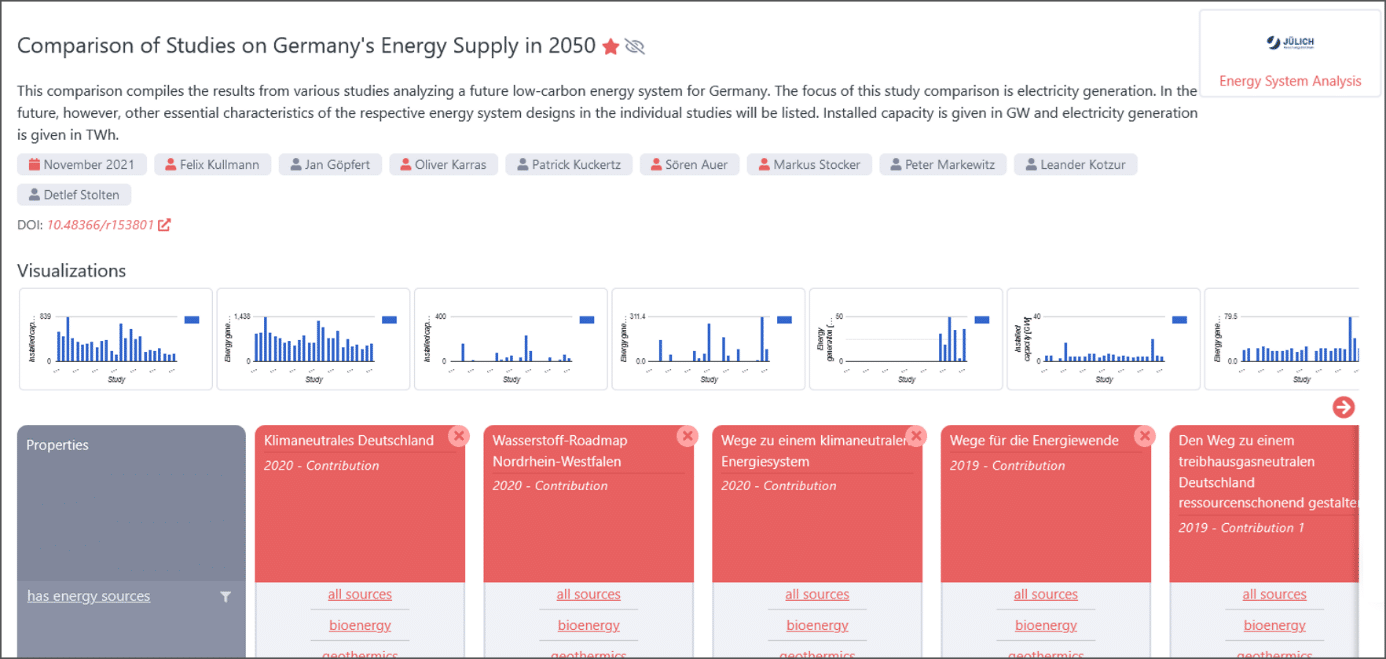
The ORKG Comparison showing the 25 energy scenarios side-by-side. The view highlights how different parameters (rows) are aligned for each study (columns), demonstrating the structured comparison.
Concrete Benefits for Engineers The transition from static text to structured knowledge offered immediate, verifiable benefits for the engineering workflow:
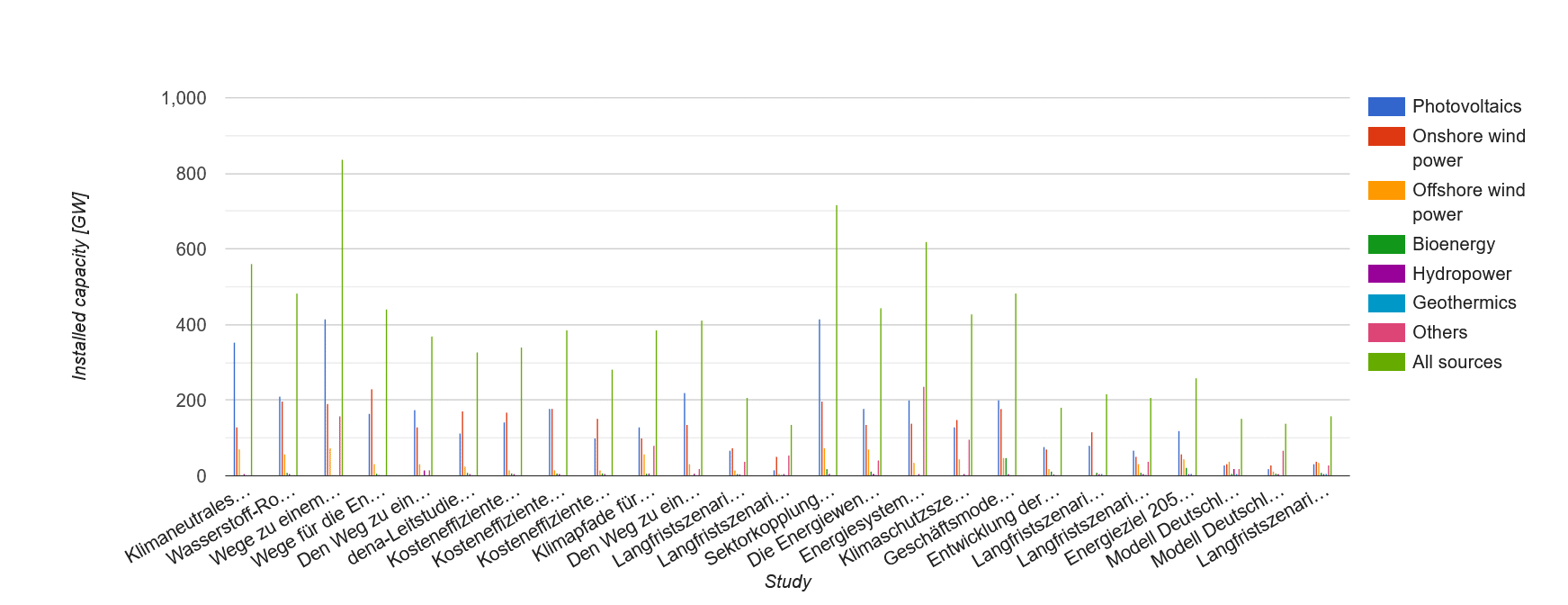
1. Instant Sensitivity Analysis: By generating visualizations (like the bar chart below) directly from the ORKG data, the researchers could instantly spot outliers and robust trends. They discovered that assumptions in the industrial sector had the greatest influence on the energy system design.
Depending solely on which framework data set was selected, the total energy generation capacity varied drastically from 120 GW to 830 GW. This crucial engineering insight was made visible through the transparent organization of data, allowing modelers to identify exactly where their input sensitivities lie.
The bar chart was generated from the ORKG data and shows the "Reported Installed capacity (GW)" across the different studies. The chart visually demonstrates the massive variance mentioned in the text, specifically distinguishing between low (120 GW) and high (830 GW) capacities.
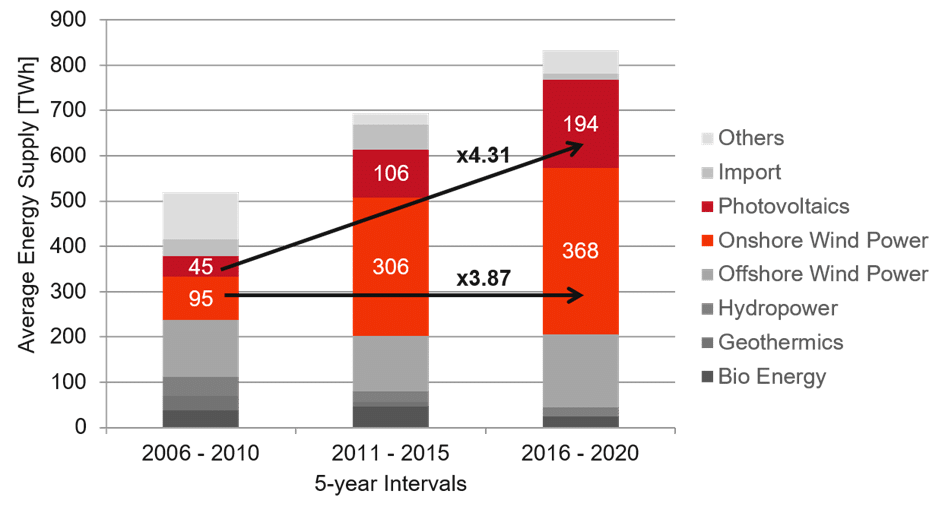
2. Machine-Actionable Reusability: Because the data is stored semantically, it can be queried by machines. Other researchers have already reused this dataset to answer new questions, such as calculating the average energy supply for specific sources over 5-year intervals. This can be done by simply running a SPARQL query over the graph, without needing to manually re-read the 25 original papers.
A visualization of the SPARQL query results showing "Average Energy Supply (TWh)" broken down by energy sources over 5-year intervals (2006-2020). This illustrates how the data can be repurposed for new analyses.
A bridge between communities: NFDI4ING & NFDI4Energy
The success of this use case has led to a significant strategic outcome: a collaborative bridge between NFDI4ING and NFDI4Energy. By aligning the engineering-specific requirements of NFDI4ING’s Task Area ELLEN with the domain-specific expertise of the energy community, a joint ORKG Observatory for Energy System Research was established. This observatory serves as a central hub where research engineers and energy experts can collectively curate, update, and compare scenarios. It ensures that the FAIR (Findable, Accessible, Interoperable, and Reusable) principles are applied not just to raw data, but to the high-level scientific knowledge and assumptions that drive our energy transition.
Conclusion This use case from Task Area ELLEN illustrates that Research Data Management (RDM) is not just about compliance; it is a powerful tool for engineering analysis. By structuring knowledge in the ORKG and fostering cross-consortia collaboration, engineers can turn isolated studies into connected, reusable, and transparent insights.
Further Reading:
Karras, J. Göpfert, P. Kuckertz, T. Pelser, and S. Auer: Organizing Scientific Knowledge From Energy System Research Using the Open Research Knowledge Graph. 1. NFDI4Energy Conference, Hannover, Germany, 2024, DOI: 10.5281/zenodo.10774919.
Karras, F. Kullmann, J. Göpfert, P. Kuckertz, J. M. Weinand, D. Stolten, S. Auer: 7. Energy Systems Analysis as an ORKG Use Case. V. Ilangovan, S. Auer, M. Stocker, L. Vogt, and S. Tiwari (Ed.): Open Research Knowledge Graph, Chapter 7, Cuvillier Verlag, 2024, URL: https://cuvillier.de/de/shop/publications/9037-open-research-knowledge-graph.
Kullmann, J. Göpfert, O. Karras, P. Kuckertz, S. Auer, M. Stocker, P. Markewitz, L. Kotzur, and D. Stolten: Comparison of Studies on Germany’s Energy Supply in 2050. Open Research Knowledge Graph, 2021, DOI: 10.48366/R153801.
Kullmann, P. Markewitz, L. Kotzur, and D. Stolten: The Value of Recycling for Low-Carbon Energy Systems – A Case Study of Germany’s Energy Transition. Energy, Volume 256, 2022, DOI: 10.1016/j.energy.2022.124660.
S. Auer, D. A. C. Barone, C. Bartz, E. G. Cortes, M. Y. Jaradeh, O. Karras, M. Koubarakis, D. Mouromtsev, D. Pliukhin, D. Radyush, I. Shilin, M. Stocker, and E Tsalapati: The SciQA Scientific Question Answering Benchmark for Scholarly Knowledge. Nature Scientific Reports 13.7240, 2023 , DOI: 10.1038/s41598-023-33607-z.